Flexible online learning
At your own time and pace
With personal guidance

More and more people are thinking about their next career move.
Sometimes because they're looking for more of a challenge. Sometimes because they want better future prospects. And sometimes because they're curious about working in IT.
But not everyone sees themselves as a programmer.
And they don't have to.
For the development of our new Functional Administrator course, we spoke with course developer Carmen about the field, the course, and why more and more people are discovering this path right now.
According to Carmen, it all started with a clear need from the job market.
"We noticed that organizations are increasingly looking for functional administrators. At the same time, we observed that many courses are quite technical. As a result, people sometimes drop out before they truly discover what the role entails."
Winc Academy wanted to approach that differently.
"We wanted to develop a practical course that is accessible to people without an IT background and that shows what the work looks like in practice."
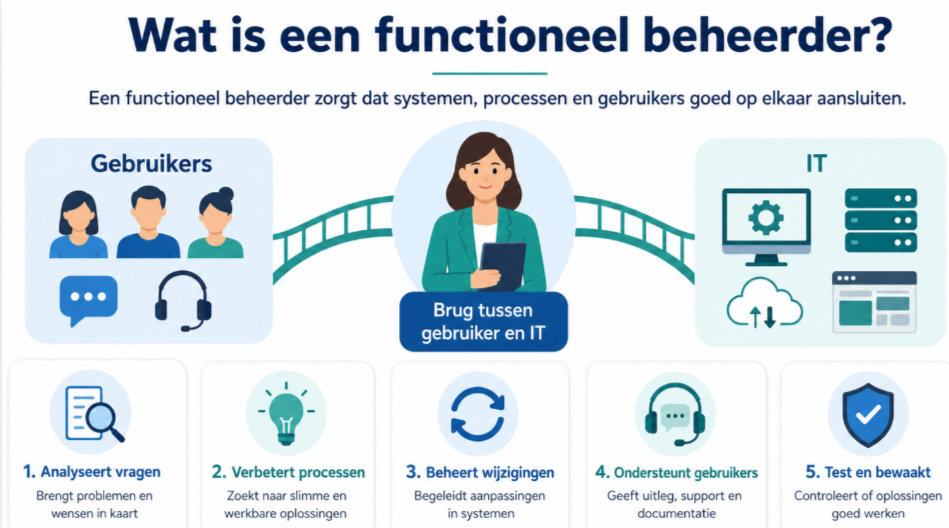
Many people have heard the job title before, but don't know exactly what a functional administrator does.
Yet you'll find them in almost every organization.
Functional administrators ensure that systems, processes, and users work well together.
"You are constantly working on the connection between people and technology." That makes the work varied and interesting."
One of the biggest misconceptions about IT is that everything revolves around programming.
According to Carmen, that perception is no longer accurate.
"There are many roles within IT where communication, analysis, and collaboration are at least as important as technical knowledge." "Functional management is a good example of this."
That makes the role interesting for career changers who are interested in IT but don't want to become a developer.
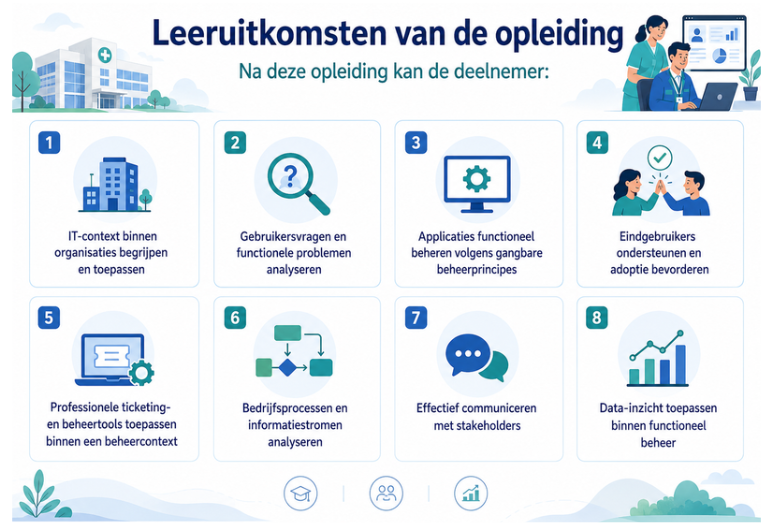
Because functional management is a practice-oriented role, practical experience is central to the training program.
Students work with, among other things:
✓ Jira
✓ Confluence
✓ user questions
✓ process analyses
✓ documentation
✓ data insights
In addition, they practice with realistic situations from the professional field.
This way, you gradually build up skills that you can apply immediately.
One of Carmen's favorite parts of the program?
The professionals sharing their experiences.
"Their stories show how versatile the profession is. You get an honest picture of the challenges, but also of what makes the work so enjoyable."
In addition to interviews, the course includes video demonstrations of commonly used tools and methods.
This means you not only get explanations, but also see what functional management looks like in practice.
%20(1).JPG)
This course is designed for people who:
✓ are considering a career switch to IT
✓ enjoy solving problems
✓ think analytically
✓ want to improve processes
✓ enjoy collaborating with different teams
You don't need to have programming experience.
You don't even need an IT background.
Curiosity, motivation, and a willingness to learn new skills are often much more important.
More and more organizations rely on digital systems.
As a result, there's a growing need for professionals who connect users, processes, and technology.
Perhaps functional management is a direction you haven't considered before.
But it might be a better fit for you than you think.